 For any query/comment related to this ebook, please contact us at haidar.ali@rekhta.org
About The Author
Identity: A popular public novelist, short story writer, and a prominent figure of Urdu popular fiction
Datt Bharti, whose real name was Devdutt Lakhan Pal, belonged to that generation of Punjabi Hindus who kept the lamps of Urdu language and culture burning even after Partition.
He was born on 26 May 1925 in the town of Basara near Phulor tehsil, district Jalandhar, East Punjab. His father was a scholar of Arabic and Persian, proficient in Sanskrit and Gurmukhi, and well-versed in astrology. He received his early education in his hometown where Urdu was his primary language. From a young age, he developed a passion for reading novels and short stories, which later became his identity.
In 1933, his family moved to Delhi and settled first on Hamilton Road and later in the Sabzi Mandi area. His father was a government employee. Datt Bharti was more inclined toward reading than formal education. As a teenager, he had already read major works of Urdu, Hindi, and English literature. His mother’s death deeply affected his sensitive temperament, and he was also married around the same time. Among his early novels, Swayamvar is especially notable for its powerful portrayal of a mother’s character.
After high school in 1937, he went to Lahore to stay with his uncle, where the literary environment deepened his attachment to Urdu literature. His father’s retirement in 1940 and subsequent illness exposed him to life’s harsh realities due to relatives’ behavior. In his autobiography 33 Bars, he admitted that hardships made him mature before his time.
After his father’s death in 1942, he had to discontinue his studies. He enrolled in a polytechnic commerce program but soon lost interest. His real education came from extensive reading. He believed reading provided mental peace and intellectual freedom. Though formally educated only up to high school, his wide reading gave him remarkable knowledge.
In 1944, inspired by a young neighbor girl named “Bharti,” he adopted the pen name “Datt Bharti” and began writing fiction. He believed extraordinary sensitivity was essential for a writer, and he possessed it in abundance.
His first piece was broadcast on radio, and in 1944 his story was published in the Delhi newspaper Tej Weekly. In 1946, while in Shimla, he wrote his first major novel Chot, later serialized in the magazine Shama, where it gained immense popularity. Crowds reportedly gathered for new issues, and the first book edition sold out immediately.
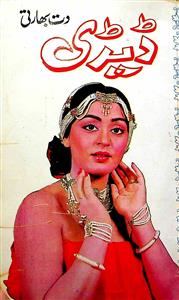
In 1958, he even filed a case over similarities between his novel and the film Pyaasa. After this, he was recognized among top novelists, and readers eagerly awaited his books. Thakan was also highly popular. Over three decades, he wrote novels such as Chot, Swayamvar, Sahara, Rahi, Janwar, Sookhe Patte, Tadap, Raakh, Gunah, and Branch Line. His story collections include Pyasi Aankhen, Gunah ke Dhabbe, and Khoobsurat Auratein Badsoorat Mard. His books were widely translated into Hindi and sold in large numbers.
He also founded his own publishing house, Bharti Book Club. Through vivid portrayals of middle-class life, love, deprivation, and social realities, he cultivated a vast readership and gave Urdu popular fiction a new identity.
Death: He passed away on 16 October 1992.
For any query/comment related to this ebook, please contact us at haidar.ali@rekhta.org