Meer Aur Ghalib
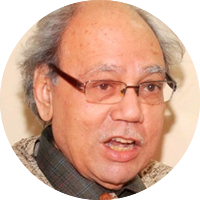
By Shamim Hanafi
When the names of Mir and Ghalib come to mind together, it is not merely because both prioritized the same poetic genre for their expression. Nor is it simply because both belonged to a literary and cultural tradition that—despite the gap in their eras—took shape in the same center of our collective life: Delhi. Despite stark differences in their personalities, creative approaches, and temperaments, they share numerous commonalities on various fronts. However, before delving into those details, let us first examine a few historical facts.
In Yadgar-e-Ghalib (A Memorial to Ghalib), Hali makes only a brief mention of Mir in connection with Ghalib, writing: The style in which Mirza [Ghalib] initially began composing Urdu poetry—setting aside the fact that we possess his verses from that period—can be well understood through this anecdote. It was recounted in Mirza's own words that Mir Taqi, who hailed from the same region as Mirza, heard the boy's early verses and remarked, 'If this boy finds an accomplished master who sets him on the right path, he will become an unparalleled poet; otherwise, he will end up spouting nonsense.'
On page 109 of Yadgar-e-Ghalib, where this passage appears, Hali also includes the following footnote: Mirza was born in 1212 AH, and Mir passed away in 1225 AH. This indicates that Mirza was about thirteen or fourteen years old at the time of Mir's death. Mirza's verses were shown to Mir Taqi by his childhood friend, the late Nawab Husamuddin Haider Khan, father of Nazir Hussain Mirza. (Yadgar-e-Ghalib 1897, 1986 edition, Ghalib Institute, New Delhi).
In an article titled Mirza Ghalib aur Mir Taqi (published in Mah-e-Nau, Karachi, February 1949), Maulana Ghulam Rasool Mehr discusses this issue regarding the connection between Mir and Ghalib. Based on various arguments, he concludes that the anecdote Hali recounts in Yadgar-e-Ghalib is inaccurate. He argues that:
(1) The phrasing Hali uses regarding the source of this anecdote suggests that he did not hear it directly from Ghalib, but rather that someone else narrated it to him.
(2) In his article, Maulana Mehr also mentions that he once expressed his doubts to Maulana Abul Kalam Azad. Azad responded with the following observation: Given Ghalib's natural aptitude and affinity for poetry, it is entirely possible that he began composing verses at the age of eleven. Because of their uniqueness and unconventional nature, people might have started talking about them, to the point that someone eventually brought them to Mir's attention. Nevertheless, Mehr's skepticism regarding the anecdote's authenticity persisted. He writes:
I am not surprised that Ghalib began writing poetry at the age of eleven. My astonishment was, and still is, over how the verses of an eleven-year-old boy traveled all the way from Agra to Mir Taqi Mir in Lucknow. Who felt the need to seek the opinion of such a seasoned and elderly master as Mir regarding these verses? Why was this need felt at all? Who in Agra had recognized Ghalib's innate brilliance at such an early stage, and then deemed it necessary to seek Mir's seal of approval for further validation? (Mah-e-Nau, Forty-Year Archive, Volume I, 1987 Edition, Idara Matbooat-e-Pakistan, Lahore).
(3) Maulana Mehr argues that, Even if Mir Taqi Mir and Mirza had resided in the same city, such an incident would still be considered astonishing given Mir's notorious 'haughtiness' or 'short temper.' Mir paid no heed to prominent poets, let alone wealthy nobles and aristocrats. How could it be possible that, at the age of ninety, he would review the verses of an eleven-year-old child and offer his critique?
(4) Maulana Mehr's skepticism regarding this anecdote about Mir and Ghalib is further reinforced by the fact that, In the final years of his life, Mir was plagued by frailty and several chronic illnesses. He was already averse to socializing and mingling, and the severe grip of his ailments turned him into a complete recluse. Three years prior to his death, his daughter passed away. The following year, he lost a son. The year after that, his wife departed from this world. The sheer weight of these tragedies had impaired his mental faculties.
In short, how can one believe such an anecdote about an elderly man whose final two or three years were consumed by failing senses and a multitude of illnesses? Is it plausible that the verses of an eleven- or twelve-year-old boy were sent all the way from Agra to Lucknow for his review, and that he examined them and remarked, If this boy finds an accomplished master who sets him on the right path, he will become an unparalleled poet; otherwise, he will end up spouting nonsense?
In Zikr-e-Ghalib, Malik Ram deems this anecdote plausible, arguing that, Even in that very early period, there was no shortage of discerning individuals who viewed Mirza's poetry with high regard and considered it worthy of being carried from one place to another as a gift. Malik Ram also believes that, The famous remark made about Ghalib bears the distinct hallmark of Mir's style. God alone knows the truth.
I am less concerned with the historical accuracy of this anecdote and more interested in a broader question: despite the stark differences in the style and rhythm of their poetry, what are the elements that draw Mir and Ghalib closer to one another? Regardless of what opinion Mir may or may not have formed about Ghalib, one thing is certain: Ghalib himself deeply acknowledged Mir's poetic genius and mastery. These two couplets—
You are not the only master of Rekhta, Ghalib,
They say in times past, there was also a Mir.
And:
Ghalib, this is my firm belief, in the words of Nasikh:
He who does not revere Mir is himself devoid of taste.
—not only string the names of Mir and Ghalib together on a single thread, but also offer a measure of the flexibility of Ghalib's intuition and the vastness of his poetic consciousness. Furthermore, Ghalib brings in Nasikh as an authority. It is as if the heights of creative experience that Ghalib discovers in Mir's poetry can be appreciated even by those who do not share a deep affinity with Mir's poetic sensibility. Obviously, despite acknowledging Nasikh's excellence, Ghalib did not adopt Nasikh's poetic style. If we examine the tradition of the ghazal as it reached Ghalib, it becomes evident that, bypassing all his predecessors—including Nasikh—Ghalib reached straight back to Mir. In another of his couplets, Ghalib declared:
What can I say of the beauty of Mir's verse, O Ghalib?
His Diwan is nothing less than the gardens of Kashmir.
In other words, for Ghalib, Mir’s collected poetry (diwan) was an extraordinary tapestry of abundant and dignified beauty, grand and fertile imagination, and diverse, colorful emotions. Within the Urdu poetic tradition, Mir is the sole figure who served as an example, a model, and an ideal for Ghalib. In his renowned essay Mir Hamare Ahd Mein (Mir in Our Times)—included in the 1982 publication Khushk Chashme Ke Kinare (pages 8–120)—Nasir Kazmi observed:
The influence of Mir's poetry on the Urdu poetic tradition is profound and far-reaching. Every master of the craft who followed him undoubtedly drew some inspiration from him, yet no one succeeded in merely imitating him. Ghalib is the only poet who skillfully and successfully absorbed Mir's style to construct an entirely new edifice of his own. In fact, I would go so far as to say that Ghalib is Mir's first truly creative student.
Did Ghalib actually imitate Mir, then? Perhaps not. There is a vast difference between their intellectual affinities, the logic of their experiences, and their modes of expression. Ghalib must have admired Nasikh as well, otherwise he would not have used him as a point of reference when discussing Mir. However, despite certain interpretations of Nasikh by Iftikhar Jalib and Shamsur Rahman Faruqi, the elements comprising the creative personalities of Nasikh and Ghalib are so fundamentally different that Nasikh's style could never have suited Ghalib. Nasikh is an architect of our poetic history, but not of our poetic tradition. Consequently, no matter how far back into the past one travels along the continuum of our tradition, one's gaze inevitably pauses at Nasikh; yet, he appears detached, even disconnected, from the central lineage of that tradition.
The names of Wali, Siraj, Sauda, Dard, Qaim, Mushafi, Aatish, and even Zauq, Zafar, and Momin are all linked to this lineage, of which Ghalib's poetry is the most luminous link. Yet, when examining Ghalib alongside his illustrious predecessors, we only look at Mir in extensive detail. There are, of course, prominent reasons for this. One is hinted at in the aforementioned quote by Nasir Kazmi: while Ghalib drew upon Mir, he ultimately constructed his own distinct edifice. Nasir Kazmi highlights the difference between the ghazals of Mir and Ghalib in another essay (titled Ghalib, also included in Khushk Chashme Ke Kinare) as follows:
Mir is a poet of emotions; he transforms even thoughts and ideas into feelings before molding them into verse. In Ghalib's poetry, however, the intellectual element is dominant. He expresses everything with a complex twist. The beauty of his work lies in how he presents old words and traditional ideas in an entirely new manner—yet he does so in a way that makes the listener feel as though this very thought had been restless for expression in their own heart for ages, only they lacked the words to articulate it.
In the same essay, Nasir Kazmi makes another noteworthy observation: Ghalib does not approach every aspect of the universe or every problem in life from a purely emotional standpoint. His inner turmoil is not born of ignorance or mere sentimentality; rather, it is the turmoil of consciousness and profound awareness—and this very turmoil is the most critical dilemma facing modern humanity. Setting aside the fact that Ghalib himself declared the heart's anguish to be the destiny of an aware mind (pech-o-taab-e-dil naseeb-e-khatir-e-aagah hai) and described blissful ignorance as a source of comfort (rashk hai aasaish-e-arbab-e-ghaflat par Asad), the question of the significance of emotion versus consciousness in poetry is far from simple. Consequently, the widely accepted notion that Mir is solely a poet of emotion while Ghalib is a poet of consciousness, intellect, and awareness has given rise to several widespread misconceptions.
In his essay on the modern ghazal (included in Lafz-o-Ma'ani), Shamsur Rahman Faruqi, while identifying the foundational styles of the new ghazal, categorized Sauda's style as a logical style. Faiz Ahmad Faiz was also a great admirer of the robustness of Sauda's style. However, it would be incorrect to conclude from this that, in contrast to Sauda, Mir's style is defined merely by passivity, a subdued tone, melancholic rhythm, and emotionality, or that it is entirely devoid of intellectual elements. Ghalib's poetry derives its allure less from its abstract concepts and philosophical thought, and more from the magical quality generated by its multiplicity of meaning. Naturally, like any great poet, Mir's poetry also creates an impression of profound semantic richness. This richness of meaning is compromised when reduced to one-dimensional intellect or one-dimensional emotion. On this level, both Mir and Ghalib stand apart from the other architects of the Urdu ghazal tradition; without imposing any heavy, superficial structural changes from the outside, both poets managed to extraordinarily expand the very essence of the ghazal.
Discussing the difference between the two, Muhammad Hasan Askari noted in his essay Ghalib Ki Infradiyat (Ghalib's Individuality, included in Takhleeqi Amal Aur Uslub): Mir wishes to absorb ordinary life into himself, whereas Ghalib wishes to expel it. That is to say, Ghalib can only conceive of spiritual elevation as leaving worldly manifestations behind and rising above them. Mir, on the other hand, seeks to attain that same spiritual elevation by remaining within those worldly manifestations and delving into their very depths. This is a somewhat far-fetched interpretation of both Mir and Ghalib. Despite the breadth of their humanistic worldviews, their attitudes toward ordinary life were highly selective. Neither Mir nor Ghalib had any desire to lose themselves in the crowd. Among the poets closely associated with the era of Mir and Ghalib, this distinction belongs almost exclusively to Nazeer Akbarabadi. Through his language, expression, tone, experience, feeling, and perception, he actively sought to endow the Urdu poetic tradition with a distinctly democratic temperament.
As for Mir and Ghalib, despite being rich in human qualities and elements, their poetry maintained an exclusive, elite register, and both shied away from adopting the path of the commoner. Firaq Gorakhpuri once labeled Zauq a panchayati (populist) poet, implying that despite Zauq's masterful command of language and intellectual grandiosity, the level of his intuition and creative experience never transcended a certain ordinary threshold. In contrast, Mir's assertion that his verses are favored by the elite (sher mere hain go khawas pasand), or Ghalib's claim that no matter how wide awareness spreads the net of hearing, it cannot capture his true meaning, both point to a profound engagement with a multi-layered and complex creative experience. Despite belonging to two different eras and possessing vastly different cultural and biographical backgrounds, numerous aspects of unity emerge in the intellectual statures of Mir and Ghalib.
Mir was unwilling to grant equal status to any of his contemporaries. Ghalib’s attitude was much the same; while he lacked Mir’s dervish-like indifference and detachment, he was acutely aware of both his own stature and the standing of his peers. No other poet of the eighteenth and nineteenth centuries possessed such a profound understanding of poetry's specific role and the uniqueness of the creative experience. Nor did anyone else exhibit such a deep, genuine sense of intellectual isolation, even while living within structured societies. Even on a superficial level, several similarities between the two come to mind. For instance, both chose Urdu and Persian as their mediums of expression. Both witnessed the horrifying spectacle of a city falling into ruin, and both endured the experience of displacement. Most importantly, however, both Mir and Ghalib transcend their respective eras. They firmly plant their feet in the sensibility of our own time, so much so that they cease to be mere predecessors and become our contemporaries.
Their authority over the twentieth-century poetic landscape is undeniable. It feels as though we are discovering ourselves through Mir and Ghalib, seeing the reflection of our own era in their chaotic times. However, during the era of Partition, mass migration, and communal riots, the experiences of eighteenth- and nineteenth-century Delhi were invoked with great fervor. The superficial and convenient methods adopted to imitate Mir during this time do not do him justice. Similarly, the way Ghalib has been celebrated in our times—under the guise of intellectual adventurism, skepticism, curiosity, and the torment of awareness—falls short of his true stature.
Relying on easily accessible linguistic formulas or merely encompassing a specific set of concepts and experiences is not enough to do justice to the two greatest poets of our literary tradition. As Muhammad Hasan Askari noted in his essay Hamare Shair aur Ittiba-e-Mir (included in Takhliqi Amal aur Uslub), even for some of the finest poets of our time, such as Firaq and Nasir Kazmi, the imitation of Mir was reduced to merely adopting melancholy and sorrow as a poetic experience. This became the sum total of their creative struggle. Such imitation is generally devoid of genuine intellectual effort. Furthermore, equating Mir’s style with merely composing couplets in a slow-paced meter using a Hindi-inflected vocabulary is a disservice both to the holistic process of poetry and to Mir’s creative stature.
Ghalib wholeheartedly acknowledged Mir’s mastery. Yet, he adopted neither Mir’s rhythm and tone, nor his language. Both possessed incredibly stable and resilient personalities, which could not be overpowered by the prevailing tastes of their respective eras, nor by their personal circumstances and life events. Given the kinds of experiences Mir and Ghalib endured, they would have shattered completely had they not been so internally strong. Creatively, the personalities of both Mir and Ghalib appear astonishingly disciplined. Their greatness and individuality stem from this inner organization—a discipline that keeps them restless but never allows them to surrender. Both managed to save themselves from drowning in the existential terror of their own being, as well as the external terror of their times. Their eras could not defeat them; rather, both emerge triumphant over their respective ages. Returning to the topic of imitating Mir, one must recall a couplet by Zauq, which perhaps contains a veiled taunt directed at Ghalib:
Alas, the style of Mir could never be attained,
Though, O Zauq, our friends tried their utmost in the ghazal.
As far as Zauq himself is concerned, this couplet can also be read as an admission of his own limitations. As for Ghalib, despite his deep reverence for Mir, he considered himself his equal. Consequently, Ghalib never attempted to adopt Mir’s style in the manner that, for example, we see in Firaq during our own times:
Firaq is often ill these days, he doesn't go out anywhere,
Sometimes we drop by his house just to ask how he is.
Blessings upon the miracle of poetry, Firaq, how did you steal this voice?
Under the veil of these ghazals, it is the ghazals of Mir that speak.
And so on. Similarly, accusing Nasir Kazmi of failing in his imitation of Mir, one of his contemporaries remarked:
Alas, the style of Mir could never be attained,
Though many a 'Babu' emerged wearing a coat and trousers.
In truth, imitation is meaningless unless it expands upon established styles. If imitation is to be meaningful, it cannot rely on the haphazard use of a dozen or so archaic idioms and obsolete words from a bygone era. Merely speaking in the familiar cadence of Delhi does not make one the successor of Mir Amman. As Askari observed, Literature created without intellectual effort is like wild mushrooms after the rain; they may cover the ground, but they provide no nourishment. A great poet draws upon a great predecessor not by merely parroting their experiences, but by ensuring that the act of imitation broadens the scope of the tradition, creating space for the expression of new experiences and emotions. In our times, the imitation of Mir and Ghalib has indeed been attempted at this higher level, leading to the creative expansion of new sensibilities, older styles, and certain fundamental human experiences. This issue, however, demands a separate, detailed discussion. Therefore, we will set it aside for now and return to Ghalib.
Had Ghalib placed ultimate importance merely on the specific words and phrases that constructed Mir’s style, or on the distinct tone and rhythm that defined his identity, he would have devoted all his energy to utilizing Mir’s poetics and vocabulary. He would not have bothered to forge a new poetic grammar or amass a new reservoir of diction. Instead, Ghalib moved beyond this superficial level. He sought to grasp Mir’s entire creative and cultural persona as an undivided whole. How did Mir protect himself from the trends of his contemporaries? How did he maintain the integrity of his creative persona amidst a demoralizing environment of chaos and decline? How did he safeguard the sanctity and dignity of poetry? For Ghalib, these were the questions of true importance. What Mir achieved through his emotional states, Ghalib achieved through his intellect and perception. The finest examples in ghazal poetry of how emotion transforms into intellect are found in Mir's work: What madness was wrought through intellect.
The nature and makeup of Ghalib's temperament were such that, first of all, he simply could not follow Mir's path. Secondly, even if he had attempted to do so, his creative insight would have fallen short of Mir's standard. Therefore, Ghalib concerned himself more with the desire for change rather than continuity. Instead of imitating Mir's tradition, he succeeded in establishing his own distinct tradition and identity. Consequently, the tradition of the ghazal appears equally embedded in the creative experiences of both poets. The truth revealed by the poetry of Mir and Ghalib is that great and genuine poetry is not bound by any set formula; rather, it comes into being through the expression of a rich, vibrant creative personality—a personality that cannot be compartmentalized into categories of high and low, or ordinary and unique.
While Mir's mode of expression reveals that profound emotions cannot be realized without the aid of consciousness, Ghalib's heaven-conquering imagination demonstrates that the highest levels of consciousness cannot be discovered without a stirring in the realm of emotions. Great poetry is always born from a simultaneous focus on the contradictory and conflicting truths of life, alongside its multidimensional experiences. Therefore, what matters is not merely how many nuances of meaning a poet has extracted from language, or how many meanings of meaning they have compressed into a single word.
What truly matters is the significance of the pathways revealed within this world of meaning—pathways that help us understand ourselves, our era, and the fundamental problems of life. What is the caliber of the insight we gain from them? What is its creative stature? How enduring is it? To what extent does this insight assist us in understanding the questions that keep the human soul restless? The art of expressing a single theme in a hundred different ways is certainly admirable, but in the final analysis, what must be examined is the true worth of that theme—and its associated variations—within the context of our personal and collective existence.
Mir and Ghalib share the distinction of casting an equally long and deep shadow over the sensibility of our own era and the universe of our experiences. Both remain equally meaningful to us, and it seems as though the convergence of their consciousness has formed a continuously expanding circle. This circle encompasses us from all sides. It has been nearly two centuries since Mir's passing (1810), and over two hundred years have gone by since Ghalib's birth (1797). Yet, our own consciousness is still not ready to step outside their circle.
By Shamim Hanafi
When the names of Mir and Ghalib come to mind together, it is not merely because both prioritized the same poetic genre for their expression. Nor is it simply because both belonged to a literary and cultural tradition that—despite the gap in their eras—took shape in the same center of our collective life: Delhi. Despite stark differences in their personalities, creative approaches, and temperaments, they share numerous commonalities on various fronts. However, before delving into those details, let us first examine a few historical facts.
In Yadgar-e-Ghalib (A Memorial to Ghalib), Hali makes only a brief mention of Mir in connection with Ghalib, writing: The style in which Mirza [Ghalib] initially began composing Urdu poetry—setting aside the fact that we possess his verses from that period—can be well understood through this anecdote. It was recounted in Mirza's own words that Mir Taqi, who hailed from the same region as Mirza, heard the boy's early verses and remarked, 'If this boy finds an accomplished master who sets him on the right path, he will become an unparalleled poet; otherwise, he will end up spouting nonsense.'
On page 109 of Yadgar-e-Ghalib, where this passage appears, Hali also includes the following footnote: Mirza was born in 1212 AH, and Mir passed away in 1225 AH. This indicates that Mirza was about thirteen or fourteen years old at the time of Mir's death. Mirza's verses were shown to Mir Taqi by his childhood friend, the late Nawab Husamuddin Haider Khan, father of Nazir Hussain Mirza. (Yadgar-e-Ghalib 1897, 1986 edition, Ghalib Institute, New Delhi).
In an article titled Mirza Ghalib aur Mir Taqi (published in Mah-e-Nau, Karachi, February 1949), Maulana Ghulam Rasool Mehr discusses this issue regarding the connection between Mir and Ghalib. Based on various arguments, he concludes that the anecdote Hali recounts in Yadgar-e-Ghalib is inaccurate. He argues that:
(1) The phrasing Hali uses regarding the source of this anecdote suggests that he did not hear it directly from Ghalib, but rather that someone else narrated it to him.
(2) In his article, Maulana Mehr also mentions that he once expressed his doubts to Maulana Abul Kalam Azad. Azad responded with the following observation: Given Ghalib's natural aptitude and affinity for poetry, it is entirely possible that he began composing verses at the age of eleven. Because of their uniqueness and unconventional nature, people might have started talking about them, to the point that someone eventually brought them to Mir's attention. Nevertheless, Mehr's skepticism regarding the anecdote's authenticity persisted. He writes:
I am not surprised that Ghalib began writing poetry at the age of eleven. My astonishment was, and still is, over how the verses of an eleven-year-old boy traveled all the way from Agra to Mir Taqi Mir in Lucknow. Who felt the need to seek the opinion of such a seasoned and elderly master as Mir regarding these verses? Why was this need felt at all? Who in Agra had recognized Ghalib's innate brilliance at such an early stage, and then deemed it necessary to seek Mir's seal of approval for further validation? (Mah-e-Nau, Forty-Year Archive, Volume I, 1987 Edition, Idara Matbooat-e-Pakistan, Lahore).
(3) Maulana Mehr argues that, Even if Mir Taqi Mir and Mirza had resided in the same city, such an incident would still be considered astonishing given Mir's notorious 'haughtiness' or 'short temper.' Mir paid no heed to prominent poets, let alone wealthy nobles and aristocrats. How could it be possible that, at the age of ninety, he would review the verses of an eleven-year-old child and offer his critique?
(4) Maulana Mehr's skepticism regarding this anecdote about Mir and Ghalib is further reinforced by the fact that, In the final years of his life, Mir was plagued by frailty and several chronic illnesses. He was already averse to socializing and mingling, and the severe grip of his ailments turned him into a complete recluse. Three years prior to his death, his daughter passed away. The following year, he lost a son. The year after that, his wife departed from this world. The sheer weight of these tragedies had impaired his mental faculties.
In short, how can one believe such an anecdote about an elderly man whose final two or three years were consumed by failing senses and a multitude of illnesses? Is it plausible that the verses of an eleven- or twelve-year-old boy were sent all the way from Agra to Lucknow for his review, and that he examined them and remarked, If this boy finds an accomplished master who sets him on the right path, he will become an unparalleled poet; otherwise, he will end up spouting nonsense?
In Zikr-e-Ghalib, Malik Ram deems this anecdote plausible, arguing that, Even in that very early period, there was no shortage of discerning individuals who viewed Mirza's poetry with high regard and considered it worthy of being carried from one place to another as a gift. Malik Ram also believes that, The famous remark made about Ghalib bears the distinct hallmark of Mir's style. God alone knows the truth.
I am less concerned with the historical accuracy of this anecdote and more interested in a broader question: despite the stark differences in the style and rhythm of their poetry, what are the elements that draw Mir and Ghalib closer to one another? Regardless of what opinion Mir may or may not have formed about Ghalib, one thing is certain: Ghalib himself deeply acknowledged Mir's poetic genius and mastery. These two couplets—
You are not the only master of Rekhta, Ghalib,
They say in times past, there was also a Mir.
And:
Ghalib, this is my firm belief, in the words of Nasikh:
He who does not revere Mir is himself devoid of taste.
—not only string the names of Mir and Ghalib together on a single thread, but also offer a measure of the flexibility of Ghalib's intuition and the vastness of his poetic consciousness. Furthermore, Ghalib brings in Nasikh as an authority. It is as if the heights of creative experience that Ghalib discovers in Mir's poetry can be appreciated even by those who do not share a deep affinity with Mir's poetic sensibility. Obviously, despite acknowledging Nasikh's excellence, Ghalib did not adopt Nasikh's poetic style. If we examine the tradition of the ghazal as it reached Ghalib, it becomes evident that, bypassing all his predecessors—including Nasikh—Ghalib reached straight back to Mir. In another of his couplets, Ghalib declared:
What can I say of the beauty of Mir's verse, O Ghalib?
His Diwan is nothing less than the gardens of Kashmir.
In other words, for Ghalib, Mir’s collected poetry (diwan) was an extraordinary tapestry of abundant and dignified beauty, grand and fertile imagination, and diverse, colorful emotions. Within the Urdu poetic tradition, Mir is the sole figure who served as an example, a model, and an ideal for Ghalib. In his renowned essay Mir Hamare Ahd Mein (Mir in Our Times)—included in the 1982 publication Khushk Chashme Ke Kinare (pages 8–120)—Nasir Kazmi observed:
The influence of Mir's poetry on the Urdu poetic tradition is profound and far-reaching. Every master of the craft who followed him undoubtedly drew some inspiration from him, yet no one succeeded in merely imitating him. Ghalib is the only poet who skillfully and successfully absorbed Mir's style to construct an entirely new edifice of his own. In fact, I would go so far as to say that Ghalib is Mir's first truly creative student.
Did Ghalib actually imitate Mir, then? Perhaps not. There is a vast difference between their intellectual affinities, the logic of their experiences, and their modes of expression. Ghalib must have admired Nasikh as well, otherwise he would not have used him as a point of reference when discussing Mir. However, despite certain interpretations of Nasikh by Iftikhar Jalib and Shamsur Rahman Faruqi, the elements comprising the creative personalities of Nasikh and Ghalib are so fundamentally different that Nasikh's style could never have suited Ghalib. Nasikh is an architect of our poetic history, but not of our poetic tradition. Consequently, no matter how far back into the past one travels along the continuum of our tradition, one's gaze inevitably pauses at Nasikh; yet, he appears detached, even disconnected, from the central lineage of that tradition.
The names of Wali, Siraj, Sauda, Dard, Qaim, Mushafi, Aatish, and even Zauq, Zafar, and Momin are all linked to this lineage, of which Ghalib's poetry is the most luminous link. Yet, when examining Ghalib alongside his illustrious predecessors, we only look at Mir in extensive detail. There are, of course, prominent reasons for this. One is hinted at in the aforementioned quote by Nasir Kazmi: while Ghalib drew upon Mir, he ultimately constructed his own distinct edifice. Nasir Kazmi highlights the difference between the ghazals of Mir and Ghalib in another essay (titled Ghalib, also included in Khushk Chashme Ke Kinare) as follows:
Mir is a poet of emotions; he transforms even thoughts and ideas into feelings before molding them into verse. In Ghalib's poetry, however, the intellectual element is dominant. He expresses everything with a complex twist. The beauty of his work lies in how he presents old words and traditional ideas in an entirely new manner—yet he does so in a way that makes the listener feel as though this very thought had been restless for expression in their own heart for ages, only they lacked the words to articulate it.
In the same essay, Nasir Kazmi makes another noteworthy observation: Ghalib does not approach every aspect of the universe or every problem in life from a purely emotional standpoint. His inner turmoil is not born of ignorance or mere sentimentality; rather, it is the turmoil of consciousness and profound awareness—and this very turmoil is the most critical dilemma facing modern humanity. Setting aside the fact that Ghalib himself declared the heart's anguish to be the destiny of an aware mind (pech-o-taab-e-dil naseeb-e-khatir-e-aagah hai) and described blissful ignorance as a source of comfort (rashk hai aasaish-e-arbab-e-ghaflat par Asad), the question of the significance of emotion versus consciousness in poetry is far from simple. Consequently, the widely accepted notion that Mir is solely a poet of emotion while Ghalib is a poet of consciousness, intellect, and awareness has given rise to several widespread misconceptions.
In his essay on the modern ghazal (included in Lafz-o-Ma'ani), Shamsur Rahman Faruqi, while identifying the foundational styles of the new ghazal, categorized Sauda's style as a logical style. Faiz Ahmad Faiz was also a great admirer of the robustness of Sauda's style. However, it would be incorrect to conclude from this that, in contrast to Sauda, Mir's style is defined merely by passivity, a subdued tone, melancholic rhythm, and emotionality, or that it is entirely devoid of intellectual elements. Ghalib's poetry derives its allure less from its abstract concepts and philosophical thought, and more from the magical quality generated by its multiplicity of meaning. Naturally, like any great poet, Mir's poetry also creates an impression of profound semantic richness. This richness of meaning is compromised when reduced to one-dimensional intellect or one-dimensional emotion. On this level, both Mir and Ghalib stand apart from the other architects of the Urdu ghazal tradition; without imposing any heavy, superficial structural changes from the outside, both poets managed to extraordinarily expand the very essence of the ghazal.
Discussing the difference between the two, Muhammad Hasan Askari noted in his essay Ghalib Ki Infradiyat (Ghalib's Individuality, included in Takhleeqi Amal Aur Uslub): Mir wishes to absorb ordinary life into himself, whereas Ghalib wishes to expel it. That is to say, Ghalib can only conceive of spiritual elevation as leaving worldly manifestations behind and rising above them. Mir, on the other hand, seeks to attain that same spiritual elevation by remaining within those worldly manifestations and delving into their very depths. This is a somewhat far-fetched interpretation of both Mir and Ghalib. Despite the breadth of their humanistic worldviews, their attitudes toward ordinary life were highly selective. Neither Mir nor Ghalib had any desire to lose themselves in the crowd. Among the poets closely associated with the era of Mir and Ghalib, this distinction belongs almost exclusively to Nazeer Akbarabadi. Through his language, expression, tone, experience, feeling, and perception, he actively sought to endow the Urdu poetic tradition with a distinctly democratic temperament.
As for Mir and Ghalib, despite being rich in human qualities and elements, their poetry maintained an exclusive, elite register, and both shied away from adopting the path of the commoner. Firaq Gorakhpuri once labeled Zauq a panchayati (populist) poet, implying that despite Zauq's masterful command of language and intellectual grandiosity, the level of his intuition and creative experience never transcended a certain ordinary threshold. In contrast, Mir's assertion that his verses are favored by the elite (sher mere hain go khawas pasand), or Ghalib's claim that no matter how wide awareness spreads the net of hearing, it cannot capture his true meaning, both point to a profound engagement with a multi-layered and complex creative experience. Despite belonging to two different eras and possessing vastly different cultural and biographical backgrounds, numerous aspects of unity emerge in the intellectual statures of Mir and Ghalib.
Mir was unwilling to grant equal status to any of his contemporaries. Ghalib’s attitude was much the same; while he lacked Mir’s dervish-like indifference and detachment, he was acutely aware of both his own stature and the standing of his peers. No other poet of the eighteenth and nineteenth centuries possessed such a profound understanding of poetry's specific role and the uniqueness of the creative experience. Nor did anyone else exhibit such a deep, genuine sense of intellectual isolation, even while living within structured societies. Even on a superficial level, several similarities between the two come to mind. For instance, both chose Urdu and Persian as their mediums of expression. Both witnessed the horrifying spectacle of a city falling into ruin, and both endured the experience of displacement. Most importantly, however, both Mir and Ghalib transcend their respective eras. They firmly plant their feet in the sensibility of our own time, so much so that they cease to be mere predecessors and become our contemporaries.
Their authority over the twentieth-century poetic landscape is undeniable. It feels as though we are discovering ourselves through Mir and Ghalib, seeing the reflection of our own era in their chaotic times. However, during the era of Partition, mass migration, and communal riots, the experiences of eighteenth- and nineteenth-century Delhi were invoked with great fervor. The superficial and convenient methods adopted to imitate Mir during this time do not do him justice. Similarly, the way Ghalib has been celebrated in our times—under the guise of intellectual adventurism, skepticism, curiosity, and the torment of awareness—falls short of his true stature.
Relying on easily accessible linguistic formulas or merely encompassing a specific set of concepts and experiences is not enough to do justice to the two greatest poets of our literary tradition. As Muhammad Hasan Askari noted in his essay Hamare Shair aur Ittiba-e-Mir (included in Takhliqi Amal aur Uslub), even for some of the finest poets of our time, such as Firaq and Nasir Kazmi, the imitation of Mir was reduced to merely adopting melancholy and sorrow as a poetic experience. This became the sum total of their creative struggle. Such imitation is generally devoid of genuine intellectual effort. Furthermore, equating Mir’s style with merely composing couplets in a slow-paced meter using a Hindi-inflected vocabulary is a disservice both to the holistic process of poetry and to Mir’s creative stature.
Ghalib wholeheartedly acknowledged Mir’s mastery. Yet, he adopted neither Mir’s rhythm and tone, nor his language. Both possessed incredibly stable and resilient personalities, which could not be overpowered by the prevailing tastes of their respective eras, nor by their personal circumstances and life events. Given the kinds of experiences Mir and Ghalib endured, they would have shattered completely had they not been so internally strong. Creatively, the personalities of both Mir and Ghalib appear astonishingly disciplined. Their greatness and individuality stem from this inner organization—a discipline that keeps them restless but never allows them to surrender. Both managed to save themselves from drowning in the existential terror of their own being, as well as the external terror of their times. Their eras could not defeat them; rather, both emerge triumphant over their respective ages. Returning to the topic of imitating Mir, one must recall a couplet by Zauq, which perhaps contains a veiled taunt directed at Ghalib:
Alas, the style of Mir could never be attained,
Though, O Zauq, our friends tried their utmost in the ghazal.
As far as Zauq himself is concerned, this couplet can also be read as an admission of his own limitations. As for Ghalib, despite his deep reverence for Mir, he considered himself his equal. Consequently, Ghalib never attempted to adopt Mir’s style in the manner that, for example, we see in Firaq during our own times:
Firaq is often ill these days, he doesn't go out anywhere,
Sometimes we drop by his house just to ask how he is.
Blessings upon the miracle of poetry, Firaq, how did you steal this voice?
Under the veil of these ghazals, it is the ghazals of Mir that speak.
And so on. Similarly, accusing Nasir Kazmi of failing in his imitation of Mir, one of his contemporaries remarked:
Alas, the style of Mir could never be attained,
Though many a 'Babu' emerged wearing a coat and trousers.
In truth, imitation is meaningless unless it expands upon established styles. If imitation is to be meaningful, it cannot rely on the haphazard use of a dozen or so archaic idioms and obsolete words from a bygone era. Merely speaking in the familiar cadence of Delhi does not make one the successor of Mir Amman. As Askari observed, Literature created without intellectual effort is like wild mushrooms after the rain; they may cover the ground, but they provide no nourishment. A great poet draws upon a great predecessor not by merely parroting their experiences, but by ensuring that the act of imitation broadens the scope of the tradition, creating space for the expression of new experiences and emotions. In our times, the imitation of Mir and Ghalib has indeed been attempted at this higher level, leading to the creative expansion of new sensibilities, older styles, and certain fundamental human experiences. This issue, however, demands a separate, detailed discussion. Therefore, we will set it aside for now and return to Ghalib.
Had Ghalib placed ultimate importance merely on the specific words and phrases that constructed Mir’s style, or on the distinct tone and rhythm that defined his identity, he would have devoted all his energy to utilizing Mir’s poetics and vocabulary. He would not have bothered to forge a new poetic grammar or amass a new reservoir of diction. Instead, Ghalib moved beyond this superficial level. He sought to grasp Mir’s entire creative and cultural persona as an undivided whole. How did Mir protect himself from the trends of his contemporaries? How did he maintain the integrity of his creative persona amidst a demoralizing environment of chaos and decline? How did he safeguard the sanctity and dignity of poetry? For Ghalib, these were the questions of true importance. What Mir achieved through his emotional states, Ghalib achieved through his intellect and perception. The finest examples in ghazal poetry of how emotion transforms into intellect are found in Mir's work: What madness was wrought through intellect.
The nature and makeup of Ghalib's temperament were such that, first of all, he simply could not follow Mir's path. Secondly, even if he had attempted to do so, his creative insight would have fallen short of Mir's standard. Therefore, Ghalib concerned himself more with the desire for change rather than continuity. Instead of imitating Mir's tradition, he succeeded in establishing his own distinct tradition and identity. Consequently, the tradition of the ghazal appears equally embedded in the creative experiences of both poets. The truth revealed by the poetry of Mir and Ghalib is that great and genuine poetry is not bound by any set formula; rather, it comes into being through the expression of a rich, vibrant creative personality—a personality that cannot be compartmentalized into categories of high and low, or ordinary and unique.
While Mir's mode of expression reveals that profound emotions cannot be realized without the aid of consciousness, Ghalib's heaven-conquering imagination demonstrates that the highest levels of consciousness cannot be discovered without a stirring in the realm of emotions. Great poetry is always born from a simultaneous focus on the contradictory and conflicting truths of life, alongside its multidimensional experiences. Therefore, what matters is not merely how many nuances of meaning a poet has extracted from language, or how many meanings of meaning they have compressed into a single word.
What truly matters is the significance of the pathways revealed within this world of meaning—pathways that help us understand ourselves, our era, and the fundamental problems of life. What is the caliber of the insight we gain from them? What is its creative stature? How enduring is it? To what extent does this insight assist us in understanding the questions that keep the human soul restless? The art of expressing a single theme in a hundred different ways is certainly admirable, but in the final analysis, what must be examined is the true worth of that theme—and its associated variations—within the context of our personal and collective existence.
Mir and Ghalib share the distinction of casting an equally long and deep shadow over the sensibility of our own era and the universe of our experiences. Both remain equally meaningful to us, and it seems as though the convergence of their consciousness has formed a continuously expanding circle. This circle encompasses us from all sides. It has been nearly two centuries since Mir's passing (1810), and over two hundred years have gone by since Ghalib's birth (1797). Yet, our own consciousness is still not ready to step outside their circle.
- Author :Shamim Hanafi
- Publication : Ghalib Institute, New Delhi
Additional information available
Click on the INTERESTING button to view additional information associated with this sher.
About this sher
rare Unpublished content
This ghazal contains ashaar not published in the public domain. These are marked by a red line on the left.