 For any query/comment related to this ebook, please contact us at haidar.ali@rekhta.org
About The Author
Identity: Renowned short story writer, playwright, translator, and a distinguished screenwriter of early Indian cinema
Pandit Sudarshan is counted among the eminent literary figures of the Indian subcontinent who not only carried forward the literary tradition of Munshi Premchand but also enriched it with new dimensions.
His real name was Pandit Badrinath Sharma, and he was born in 1896 in Sialkot into a wealthy zamindar family. He obtained a Bachelor’s degree in Literature, which laid a strong foundation for his intellectual and literary career.
Sudarshan began his literary journey by writing for the famous Urdu journal “Hazaar Dastaan” in Lahore. He is considered a contemporary of Munshi Premchand, as his writings reflect simplicity, emotional depth, and a deep sense of humanity. His first short story, “Haar Ki Jeet” (1920), brought him widespread recognition. It narrates the moral victory of a farmer striving to save his beloved horse from a dacoit. His stories span both rural and urban life, portraying the emotions of the middle class with remarkable skill.
While Munshi Premchand could not make a significant mark in cinema, Pandit Sudarshan successfully utilized this medium. With the advent of talkies, he moved to Calcutta and soon became associated with major film studios.
His debut film was “Ramayan,” featuring Prithviraj Kapoor. He later collaborated with the renowned “New Theatres” and created several notable works. In 1935, for the film “Dhoop Chhaon,” he not only wrote the screenplay but also composed all ten songs. One of his songs, “Teri gathri mein laga chor, musafir jaag zara,” remains a classic. After moving to Mumbai, he wrote the screenplay and dialogues for Sohrab Modi’s famous film “Sikandar,” achieving great acclaim.
Pandit Sudarshan left a rich legacy in both Hindi and Urdu literature:
Short story collections: Kunj-e-Aafiyat, Qudrat ke Khel, Paras, Chatkiyan, Sada Bahar, Tehzeeb ke Taziyane, etc.
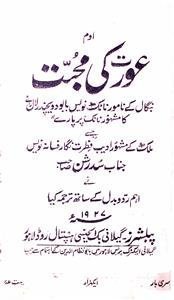
Plays: Aurat ki Mohabbat, Mahabharat, Mohabbat ka Intiqam, Qaum Parast.
Film works: Prithvi Vallabh, Pattharon ka Saudagar, Jaltarang, Phir Milenge.
Translation: Dayanand Prakash.
His writings were so impactful that even Mahatma Gandhi admired them. In his later years, he returned to writing for books and journals, where his focus shifted from rural themes to urban issues.
Death: He passed away on 16 December 1967 at Harkishan Das Hospital in Mumbai.
For any query/comment related to this ebook, please contact us at haidar.ali@rekhta.org