ALL
Profile
Ghazal233
Sher396
E-book1037
TOP 20 SHAYARI 20
Image Shayari45
Audio82
Video323
Marsiya1
Qita28
Rubai34
Qisse18
Blog12
Other
Sehra3
Non prevalent ghazals238
Qadir Nama1
Qasida10
Salam1
Mukhammas1
Masnavi3
Non prevalent Sher59
Letter48
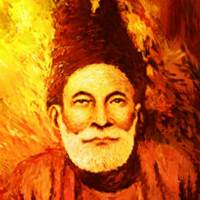
Mirza Ghalib
Ghazal 233
Sher-o-Shayari 396
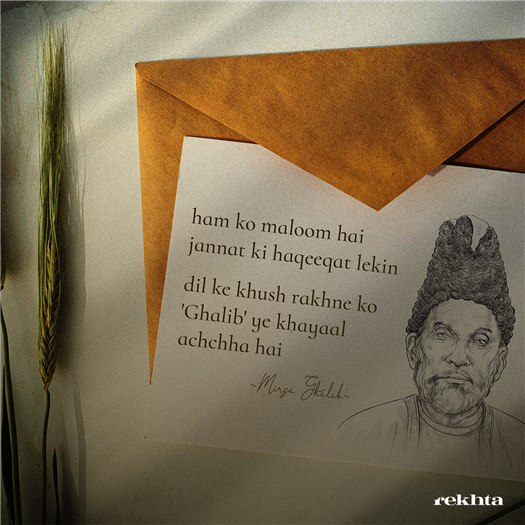
ham ko ma.alūm hai jannat kī haqīqat lekin
dil ke ḳhush rakhne ko 'ġhālib' ye ḳhayāl achchhā hai
We are well aware of the actual reality regarding Paradise, but...
To keep the heart happy, Ghalib, this idea is quite good.
The poet expresses a witty skepticism regarding the religious promise of the afterlife. He implies that while he knows the 'truth' about Paradise (perhaps that it is metaphorical or non-existent), the concept itself serves a useful psychological purpose. It acts as a comforting illusion that allows people to find joy and endure life's hardships through hope.
hum ko malum hai jannat ki haqiqat lekin
dil ke KHush rakhne ko 'ghaalib' ye KHayal achchha hai
We are well aware of the actual reality regarding Paradise, but...
To keep the heart happy, Ghalib, this idea is quite good.
The poet expresses a witty skepticism regarding the religious promise of the afterlife. He implies that while he knows the 'truth' about Paradise (perhaps that it is metaphorical or non-existent), the concept itself serves a useful psychological purpose. It acts as a comforting illusion that allows people to find joy and endure life's hardships through hope.
ishq ne 'ġhālib' nikammā kar diyā
varna ham bhī aadmī the kaam ke
Ghalib, a worthless person, this love has made of me
otherwise a man of substance I once used to be
Love has rendered Ghalib completely useless and idle.
Otherwise, I too was a capable person of great worth.
The poet humorously yet sorrowfully confesses that the pursuit of love has consumed all his worldly potential. He reflects on his former self, claiming that before falling in love, he possessed great utility and capability, which has now been wasted away by his passion.
ishq ne 'ghaalib' nikamma kar diya
warna hum bhi aadmi the kaam ke
Ghalib, a worthless person, this love has made of me
otherwise a man of substance I once used to be
Love has rendered Ghalib completely useless and idle.
Otherwise, I too was a capable person of great worth.
The poet humorously yet sorrowfully confesses that the pursuit of love has consumed all his worldly potential. He reflects on his former self, claiming that before falling in love, he possessed great utility and capability, which has now been wasted away by his passion.
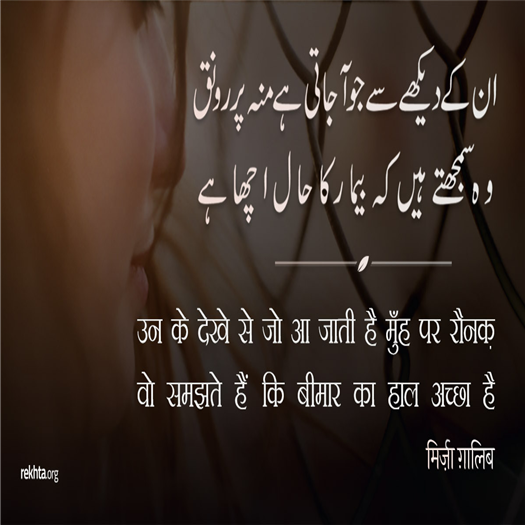
un ke dekhe se jo aa jaatī hai muñh par raunaq
vo samajhte haiñ ki bīmār kā haal achchhā hai
When I see them, a sudden glow comes to my face.
They assume that means the sick person is doing well.
The beloved’s presence briefly brings color and liveliness to the lover’s face, even though the inner pain remains. That passing ‘radiance’ becomes a misleading sign: onlookers judge health by appearance. The couplet captures how love can animate someone for a moment while the real illness—of heart or longing—stays untouched, creating a poignant misunderstanding.
un ke dekhe se jo aa jati hai munh par raunaq
wo samajhte hain ki bimar ka haal achchha hai
When I see them, a sudden glow comes to my face.
They assume that means the sick person is doing well.
The beloved’s presence briefly brings color and liveliness to the lover’s face, even though the inner pain remains. That passing ‘radiance’ becomes a misleading sign: onlookers judge health by appearance. The couplet captures how love can animate someone for a moment while the real illness—of heart or longing—stays untouched, creating a poignant misunderstanding.
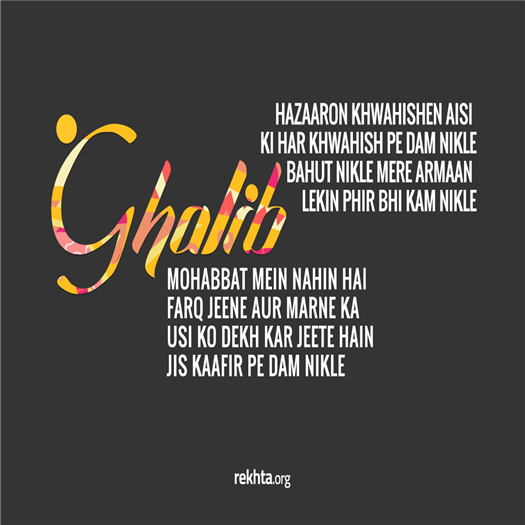
mohabbat meñ nahīñ hai farq jiine aur marne kā
usī ko dekh kar jiite haiñ jis kāfir pe dam nikle
In love there is no difference 'tween life and death do know
The very one for whom I die, life too does bestow
In love, living and dying feel the same; there is no real difference.
We keep ourselves alive only by looking at the beloved whose glance can take our breath away.
The couplet says that true love dissolves the boundary between life and death: both become equally acceptable states. The lover’s survival depends on the beloved’s presence, yet that same beloved is so cruel or powerful that a single look can kill. This tension—being sustained and destroyed by the same sight—captures the intensity and helpless devotion of عشق.
mohabbat mein nahin hai farq jine aur marne ka
usi ko dekh kar jite hain jis kafir pe dam nikle
In love there is no difference 'tween life and death do know
The very one for whom I die, life too does bestow
In love, living and dying feel the same; there is no real difference.
We keep ourselves alive only by looking at the beloved whose glance can take our breath away.
The couplet says that true love dissolves the boundary between life and death: both become equally acceptable states. The lover’s survival depends on the beloved’s presence, yet that same beloved is so cruel or powerful that a single look can kill. This tension—being sustained and destroyed by the same sight—captures the intensity and helpless devotion of عشق.
pūchhte haiñ vo ki 'ġhālib' kaun hai
koī batlāo ki ham batlā.eñ kyā
She feigns ignorance and asks others, Who is this person named Ghalib?
Someone please advise me, what answer should I give to such a question?
This couplet highlights a moment of witty irony and deep pathos where the beloved pretends not to know the poet, despite his fame being entirely due to his love for her. Ghalib is left speechless, wondering how to define his identity to the very person who is the center of his existence.
puchhte hain wo ki 'ghaalib' kaun hai
koi batlao ki hum batlaen kya
She feigns ignorance and asks others, Who is this person named Ghalib?
Someone please advise me, what answer should I give to such a question?
This couplet highlights a moment of witty irony and deep pathos where the beloved pretends not to know the poet, despite his fame being entirely due to his love for her. Ghalib is left speechless, wondering how to define his identity to the very person who is the center of his existence.